
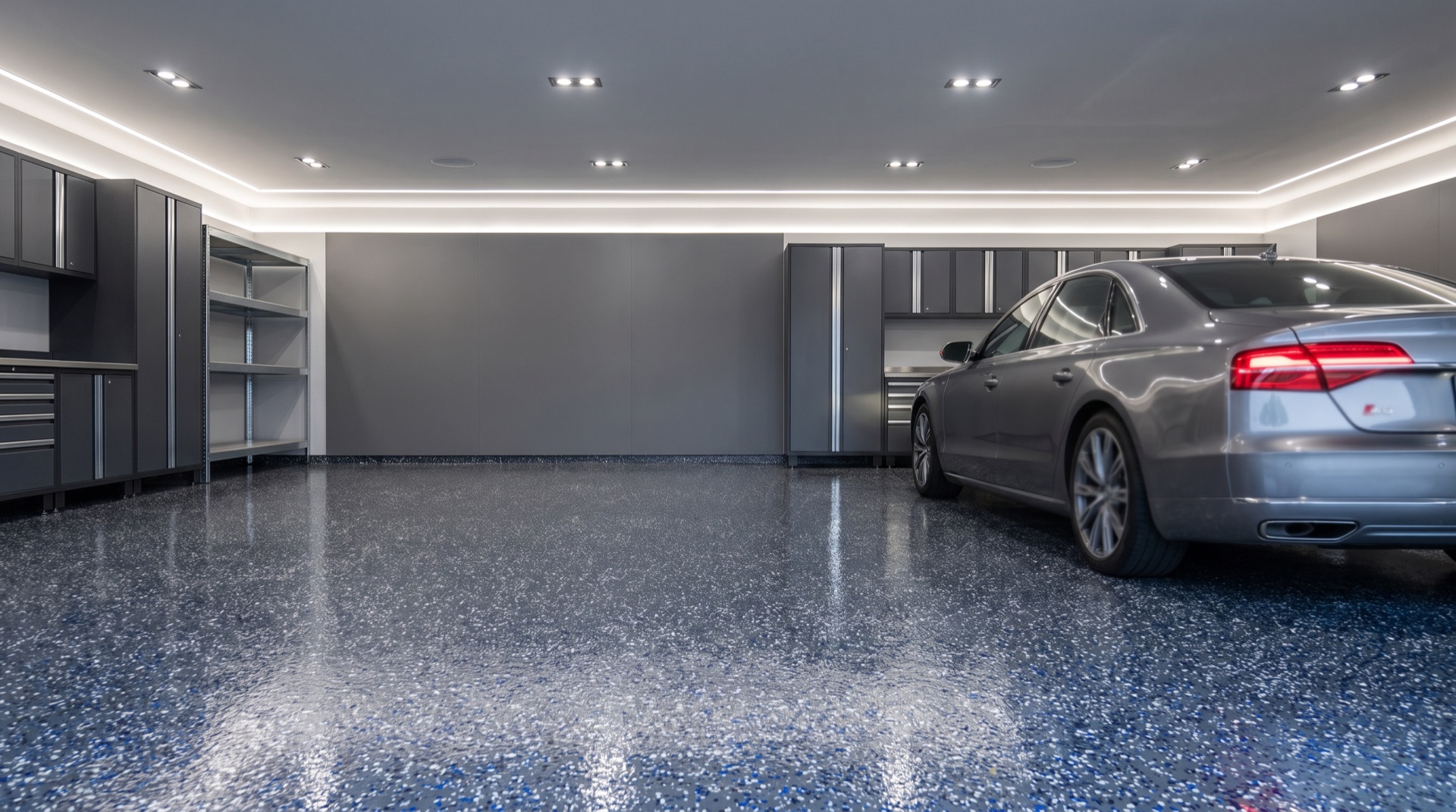
A garage floor built for hot tires, humidity, and daily abuse
Your garage slab takes more punishment than any floor in the house — hot tires straight off I-295, dropped tools, oil drips, a pressure washer, and the swing between a closed 95° garage and an AC'd laundry room. Bare concrete just soaks it all up: it dusts, stains, and cracks. A coated floor seals the slab under a hard, chemical-resistant surface you can mop clean and actually keep bright.
The catch is that garage floor epoxy is only as good as the prep underneath it. Big-box roll-on epoxy kits and "one-day" crews that acid-etch and roll fail the same way here — they lift off in sheets with the first hot-tire summer. What we install is a mechanically ground, resin-bonded system, not a paint. That difference is the whole page. (Deciding between options? See paint vs. epoxy vs. pro coating.)
The Florida wedgePrep drives roughly 90% of a coating's lifespan. The failures you see in Jacksonville garages — peeling corners, bubbling, hot-tire pickup — are almost never the resin. They're skipped grinding, untested slab moisture, or an unrepaired crack. Our installers diamond-grind every slab and moisture-test before a drop of coating goes down.
The one-day flake system, step by step
A standard 2-car garage is a single-day job (full timeline here). Here's exactly what happens on the slab:
- Diamond grinding. The slab is mechanically ground with diamond tooling to open the concrete pores and create a mechanical profile the coating locks into — no acid, no guesswork.
- Crack & joint repair. Every crack, spall, and control joint is chased out and filled with a rigid polymer patch, then re-ground flush so it disappears under the finish.
- Polyurea base coat. A fast-curing polyurea (or high-build epoxy) base is squeegeed and back-rolled into the profiled slab.
- Flake broadcast to refusal. Decorative vinyl flake is thrown into the wet base until the floor won't take any more — that "broadcast to refusal" is what gives the finished floor its texture and grip.
- Scrape & polyaspartic top coat. Once cured, the loose flake is scraped back and a UV-stable polyaspartic clear coat seals everything into one solid, glossy surface.
Walk on it in a few hours, park on it in about 24. No resealing, no waxing — just sweep and mop.
What a garage floor coating costs in Jacksonville
Installed garage floor coatings in the Jacksonville area run about $4.50–$8.50 per square foot. For the common sizes that works out to roughly:
- 2-car garage (400–500 sq ft): about $2,000–$4,250
- 3-car garage (600–750 sq ft): about $2,700–$6,375
- Single bay (250–300 sq ft): about $1,150–$2,550
Where you land in that range depends on three things: the system (an interior epoxy flake floor costs less than a full polyurea/polyaspartic build), the slab's condition (heavy cracking, pitting, or a previous failed coating that has to be ground off adds labor), and the finish (standard flake vs. a metallic design). DIY kits look cheaper at $2.50–$4/sq ft, but they skip the grinder — which is exactly why they fail. Every quote we send is free and itemized. Still weighing the investment? Read is an epoxy garage floor worth it?
Colors & finishes
Flake blends are the most popular garage finish — a base color with a custom mix of flake that hides dust, tire marks, and minor slab imperfections. Domino, pewter, and coastal-grey blends are the Jacksonville favorites, but there are hundreds of combinations — our finishes guide compares flake, metallic, and solid color. Want something more dramatic? Ask about metallic epoxy floors for a marbled, high-gloss "3D" look, or a solid-color industrial finish for a workshop.
New build in Nocatee, St. Johns or RiverTown?A fresh slab is the cheapest, cleanest floor to coat — no old paint to grind off and no years of oil soaked in. If your garage is bare concrete right now, that's the ideal moment. See why polyaspartic beats epoxy here →